| HISTORICAL SITES |
KALKAN - PATARA |

PATARA
| At about 10 kms. beyond Kalkan on the Kalkan-Fethiye highway you
turn south and continue 10 kms. along the road to Patara. The painted ceramics found in
the acropolis prove that the city existed in the 5th century B.C. Patara opened its doors
to Alexander the Great, thereby earning the status of an important harbour city, in
addition to having been the birthplace of St. Nicholas. The triple gateway through which
one enters Patara is thought to have been built in 100 A.D. One of its most important
edifices is its theatre which is now buried in sand. |
Please click on photos for larger view !
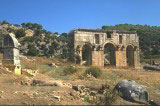
Mettius Modestus victory gate
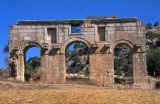
Mettius Modestus victory gate
|
XANTHOS
| This is the oldest and the largest city of the mountain province of
Lycia, settled in the valley of the Xanthos river. Until the Persian invasion it was an
independent state. When the people of Xanthos,who had bravely tried to defend their city,
realized that they could not repulse the invasion, they first killed their women committed
mass suicide by throwing themselves into the flames. About 80 surviving families and
people who immigrated there rebuilt the city, but a fire which broke out about 100 years
later razed it to the ground. In spite of this, the city was again rebuilt and, as a
result of establishing good relations with the west, was considered as an important
centre. However, Xanthos again met with an unfortunate end. As a result of resisting the
taxes the Athenians wanted to impose on them in 429 B.C., the city was largely destroyed
and the inhabitants were drawn into a war. And thus Xanthos became "a city of
disasters". The city itself consists of the Lycian acropolis and the parts remaining
outside it, as well as the Roman acropolis. The most interesting building is the Roman
theatre and the edifices of the theatre's western shoreline. Of these the most famous is
the Harpy Monument, which is a family sarcophagus situated on a rock. The original of this
relief-decorated sarcophagus is in the British Museum, and a very good copy of this is in
its place. Close by can be seen very interesting Lycian sarcophagi from the 6th and 1st
centuries B.C. |

Harpy Monument and Lycian sarcophagus
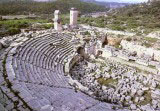
Xanthos theatre
|
LETOON
| To reach Letoon, you turn west one kilometer beyond the road from
KINIK to Fethiye and continue 5 km. The history of Letoon is closely linked with that of
Xanthos. It is known to have been one of the most important religious centers of the
Lycian region. Due to the rising water level, archeological digs have been suspended. The
remains unearthed indicate they belong to the period between the 7th century B.C. and the
6th century A.D. The most important edifice is the Greek style theater which has been
preserved until our day. |
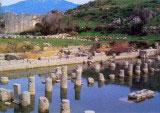
Letoon
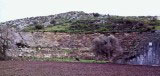
Letoon theatre
|
|


